Start here
Your first government contract,
step by step
The paperwork is the easy part and it is free. The hard part starts after: 26,174 contracts are open right now across 6,386 buying agencies, and knowing which five deserve your week is the whole job.
Full Pro access · nothing charged for 7 days · cancel in one click
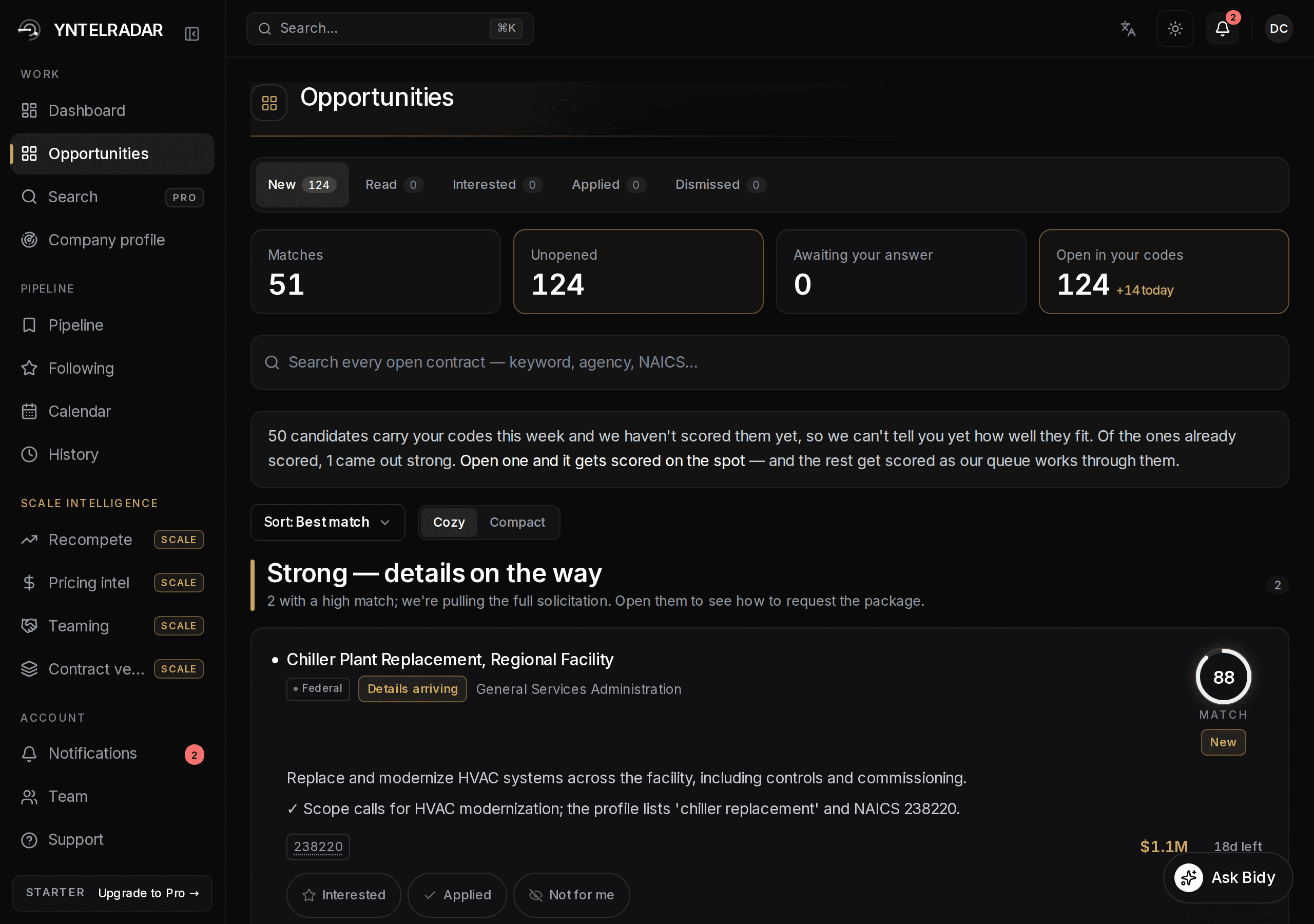
Your first scored feed — the strong ones first, with the reason each one matched.
The seven steps, and what each one costs you
In order, because they are one: you cannot register the entity without a UEI, and you cannot bid without the registration.
Get your UEI
The Unique Entity ID is the number the government knows you by. You request it on SAM.gov and it is issued in days.
Free. Do it yourself — anyone charging for this is selling you what the government gives away.
Register your entity in SAM.gov
This is what makes you eligible to receive an award. Expect two to three weeks, mostly waiting on validation.
Also free. Set a calendar reminder for the annual renewal — letting it lapse makes you ineligible at the worst moment.
Pick the codes that describe your work
NAICS codes are the first filter a contracting officer applies. Pick the ones that match what you actually do, not the widest ones you could argue for.
A code is wider than the work you actually do — one can cover two jobs you would never bid. We score on the solicitation text too, so you get your work and not the code's.
Find the ones worth your week
This is where beginners lose. There are more open notices than anyone can read, they are spread across hundreds of portals, and the good ones close fast.
Every notice scored 0–100 against your business, with the reasons written out so you can check them.
Read the solicitation — or have it read
Dozens of pages, most of which you read only to discard. The mandatory site visit is on page 40 and the evaluation criteria decide the award.
We pull out the requirements, the deadlines and the mandatory meetings, and put them in your plan.
Price it against what the government paid
The lowest price rarely wins, and when it does it usually ruins whoever set it. What you need is the range that actually gets awarded.
Worked out from real award history for comparable contracts — not an estimate.
Write it and submit
Your first proposal is the hardest. The second takes half as long.
Drafted from the solicitation with the evaluation criteria in front of it, then tracked step by step until submitted.
Steps 3 to 7, done for you
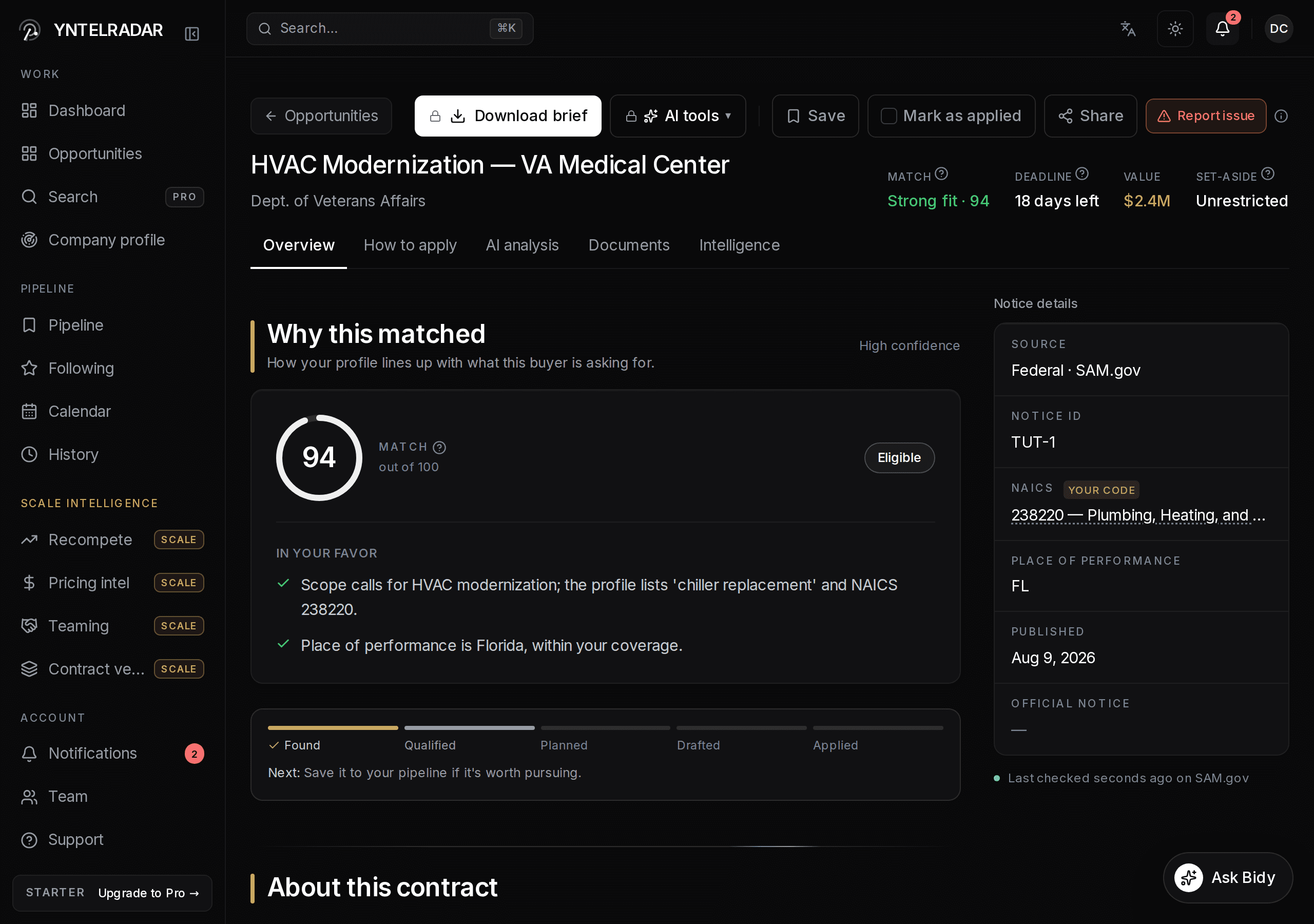
Open any notice: the match score, why it fits your business, the documents read, and the bid drafted.
Tools for your next opportunity
From discovery to a well-prepared proposal
Bring research, analysis and preparation into one workspace, with tools for each stage of your team's work.
Federal, state and local
Explore U.S. government opportunities from federal, state and local sources. Check the coverage map and your plan to see what is available where you work.
Understand the fit
Use a fit score and its supporting reasons to prioritize notices based on your business profile, industry codes and locations.
Review requirements with AI
Use AI analysis to review the scope, requirements and dates in available solicitation information. Consult the original documents to confirm the details before submitting.
Add context to your pricing
With Scale, use available award history and comparable amounts to inform your pricing research alongside your own costs and delivery requirements.
Research previous awards
From Pro, consult available award history to learn which companies received contracts, from which agencies and for what amounts.
Plan for potential recompetes
With Scale, research contracts approaching their estimated end dates and plan your outreach. These signals support planning; they do not confirm a future solicitation.
Explore teaming partners
With Scale, research potential partners whose capabilities complement your team's, and review the available information to assess the fit.
Start with a proposal draft
From Pro, prepare AI-assisted proposal drafts using solicitation information and your business profile. Review, adapt and complete the content before submission.
Keep your next steps organized
Track the opportunities you choose to pursue, organize capture tasks and export deadlines to your calendar in .ics format.
Follow relevant updates
Receive opportunity digests and follow changes to notices. Digest frequency and access to instant alerts depend on your plan.
Work in English or Spanish
Choose your working language for the dashboard and AI-assisted analysis. Official documents retain their original language and submission requirements.
Choose the tools that match your team's needs. Features, usage limits and coverage vary by plan.
The right tools for your next opportunity.
Start free for 7 days — full Pro access. Cancel in one click, no call.
Opportunity discovery, proposal support and contract intelligence — from $79/mo.
State coverage grows as coverage expands — see the roadmap.
Federal coverage nationwide on every plan · state and local monitoring for the states in your plan (2 / 5 / all 50). Intelligence is what you upgrade for.
Try Pro for free
Try Pro free — 7 days of full Pro · no credit card · then $79/mo if you stay
for 7 days
Cancel in one click.
Everything in Pro
Pro
Most popularFor teams that bid seriously and can't miss a deadline.
$65.83/mo, billed yearly list price · 20% off
Launch pricing — limited time. Lock yours for as long as you stay subscribed.
$632 billed yearly · 4 months free
Billed yearly. Cancel anytime.
Launch pricing — rates will rise as we grow. Lock yours for as long as you stay subscribed.
Included:
- Every federal opportunity, scored 0–100 with the reasons
- One-line summary on 4 of every 5 notices
- Full solicitation text + attachments (federal)
- Pipeline tracking with notes
- Read / unread + amendment tracking
- Deadline reminders
- Federal coverage nationwide on every plan · state and local monitoring for the states in your plan (5 / all 50)
- The AI that explains it and drafts it for you
- Who won similar contracts + historical award values
- Full application guide — how to actually bid
- Bidy, your AI secretary — acts on your bids
- AI proposal drafts, compliance matrix, email the officer
- AI search — ask in your own words, Bidy finds it
- PDF brief for any contract
- Win Plan + calendar
- Global + saved searches · full history · CSV export
- 3 seats · priority support
Scale
Most powerfulFor agencies running many pipelines at once.
$332.5/mo, billed yearly list price · 20% off
Launch pricing — limited time. Lock yours for as long as you stay subscribed.
$3192 billed yearly · 4 months free
Billed yearly. Cancel anytime.
Launch pricing — rates will rise as we grow. Lock yours for as long as you stay subscribed.
Everything in Pro, plus:
- Every state we cover — pre-selected, editable
- Local coverage — cities & counties, added weekly
- Recompete predictor — get known before the RFP drops
- Teaming matchmaking — the partner that closes your eligibility gap
- Pricing intelligence — what similar work actually got awarded
- Scale intelligence inside every contract you open
- Deeper briefs — recompete, pricing & teaming built in
- Agency-level, multi-pipeline coverage
Steps 1 and 2 are yours. We do 3 to 7.
Get the UEI and the registration — they are free and they take a few weeks. By the time they clear, your feed can already be waiting: scored, read and ready to bid. Seven days of full Pro access, nothing charged for seven days.
How long before I can bid on my first contract?
The paperwork takes a few weeks: a UEI is issued in days, and the SAM.gov entity registration usually clears in two to three. After that you are eligible immediately — there is no waiting period and no minimum size. What actually delays most first bids is not the registration, it is not knowing which solicitation to spend the week on.
Does it cost anything to register?
No. Getting a UEI and registering your entity in SAM.gov are free, and you do them yourself. Anyone charging you hundreds of dollars for it is selling you something the government gives away — a genuinely common scam in this industry, and worth saying plainly.
Do I need past performance to win anything?
Not for everything. Simplified acquisitions and micro-purchases exist precisely for smaller, faster buys, and they are where most first wins happen. The trick is finding them among everything else, which is what the scoring is for.
What is the hardest part for a beginner?
Reading. A solicitation runs to dozens of pages and most of that reading exists only to decide whether to walk away. That is the cost nobody warns you about, and it is the single largest thing YNTELRADAR takes off your desk.